

 What Is an ECG?

Ghar Pe Diagnostics provides ECG at home in JP Nagar for patients who need a planned 12-lead heart rhythm test without travelling to a hospital or diagnostic centre. A trained technician visits the patient's home with portable ECG equipment, places small electrode patches on the chest and limbs, and records the heart's electrical activity.
Home ECG can be especially practical for senior citizens, people with limited mobility, patients needing doctor-advised follow-up and those recently discharged from hospital. It is meant for stable, planned testing. Severe chest pain, fainting, collapse, heavy sweating with chest discomfort or severe breathlessness requires urgent medical care rather than waiting for a home ECG.
What Is an ECG Test?
An ECG, or electrocardiogram, is a simple test that records the electrical signals made by the heart.
Every heartbeat is controlled by electrical activity. An ECG turns that activity into a tracing that helps a healthcare professional look at:
- Heart rate
- Heart rhythm
- Fast or slow heartbeat
- Irregular heartbeat
- Electrical conduction patterns
- Changes that may need further heart evaluation
Small adhesive patches called electrodes are placed on the skin and connected to the ECG machine.
The test does not send electricity into your body. It only records the heart's existing electrical activity. ECG is generally painless, although removing the adhesive patches can cause minor temporary discomfort or skin irritation.
What Does ECG at Home Mean?
ECG at home means the same type of resting ECG is recorded at the patient's residence using portable equipment.
Instead of travelling to a diagnostic centre, the patient remains at home while the technician sets up the equipment and records the tracing.
This can be useful when travelling is difficult because of age, weakness, limited mobility or recovery after hospitalisation.
Patients who want the broader city-level service information can also read about ECG at home in Bangalore.
What Is a 12-Lead ECG?
A 12-lead ECG is the standard resting ECG commonly used in healthcare.
The word "12-lead" can sound confusing. It does not mean 12 wires are inserted into the body. Small electrode patches are placed on the chest and limbs, and the machine uses them to record the heart's electrical activity from 12 different views.
This gives a doctor more information than a simple single-lead reading from many watches or personal devices.
Ghar Pe Diagnostics currently provides 12-lead ECG testing at home in Bengaluru using portable ECG equipment.
Why Book ECG at Home in JP Nagar?
For a healthy and mobile person, travelling for a short ECG may be manageable. The same trip can be much harder for an elderly patient, someone recovering after hospital discharge or a person who depends on a caregiver for transport.
Home ECG can reduce that practical burden when the patient is stable and the test has been advised.
It may be useful for:
- Senior citizens with reduced mobility
- Bedridden or physically weak patients
- People needing doctor-advised rhythm checks
- Patients with recurrent palpitations
- People needing follow-up after hospital discharge
- Patients who have been advised an ECG before a procedure
- People who need a repeat ECG for comparison
- Patients who already have a treating doctor and need a new tracing
JP Nagar is included within Ghar Pe Diagnostics' stated Bengaluru ECG service coverage.
Who May Need an ECG?
A doctor may recommend an ECG when they need information about how the heart is beating.
Common reasons include:
- Palpitations
- A fast heartbeat
- A slow heartbeat
- An irregular heartbeat
- Dizziness or light-headedness
- Fainting episodes
- Breathlessness
- Chest discomfort
- Follow-up after a known heart condition
- Pre-operative assessment
- Monitoring after hospital discharge
Having high blood pressure or diabetes does not automatically mean everyone needs an ECG. These conditions can increase heart risk, but the need for testing depends on the person's symptoms, history and doctor's assessment.
If you have symptoms but do not know which test you need, a doctor visit at home may be a better starting point than choosing an ECG yourself.
ECG at Home for Senior Citizens in JP Nagar
Home ECG can be particularly practical for older adults.
A short diagnostic-centre visit may still involve:
- Arranging transport
- Moving between the home and vehicle
- Wheelchair assistance
- Caregiver support
- Waiting at the facility
- Repeating the same transfers on the way back
If the patient is medically stable and a doctor has advised an ECG, performing the recording at home can reduce these logistical difficulties.
Doctors may request ECG for an older adult who needs:
- Heart rhythm follow-up
- Evaluation of palpitations
- Repeat monitoring
- Post-discharge assessment
- Pre-surgery ECG
- Review after previous cardiac treatment
Age alone is not a reason to choose home testing. An elderly person with severe new chest pain, fainting, severe breathlessness or collapse needs urgent medical assessment.
ECG at Home for Palpitations
Palpitations can feel like:
- The heart is racing
- The heart is pounding
- The heart is fluttering
- A beat is being skipped
- The rhythm feels irregular
An ECG can detect many abnormal rhythms if the rhythm is present while the recording is being taken.
This is an important limitation.
A standard ECG only records the heart for a short period. If the palpitations come and go, the ECG may look normal between episodes.
When symptoms are intermittent, a doctor may recommend longer monitoring such as a Holter monitor or an event recorder. A Holter monitor records heart activity continuously for 24 to 48 hours or longer, which can help capture rhythms that do not occur during a short ECG.
Palpitations with fainting, severe breathlessness, severe chest pain or collapse require urgent assessment.
ECG for Chest Discomfort: What You Should Know
An ECG is commonly used as part of the assessment of chest discomfort because it can show electrical changes that may be related to the heart.
However, an ECG cannot tell you the cause of every type of chest discomfort.
Depending on the symptoms, a doctor may also recommend:
- Blood tests
- Troponin testing
- Echocardiography
- Chest imaging
- Lung-function testing
- Other cardiac investigations
For some respiratory symptoms, a doctor may advise a PFT test at home. For selected chest or lung imaging requirements, X-Ray at home in Bangalore may also be relevant.
Do not use a planned home ECG to decide whether severe chest pain is an emergency.
Can an ECG Detect an Arrhythmia?
Yes, an ECG can detect many arrhythmias when the abnormal rhythm occurs during the test.
An arrhythmia simply means that the heart rhythm is too fast, too slow or irregular.
An ECG may help show:
- Fast rhythms
- Slow rhythms
- Irregular rhythms
- Conduction abnormalities
- Changes that need further evaluation
If the ECG is normal but symptoms continue to come and go, the doctor may recommend longer rhythm monitoring.
The American Heart Association notes that Holter and event monitors are useful because a standard ECG provides only a brief view of heart activity.
Can an ECG Detect a Heart Attack?
An ECG is an important test when a heart attack is suspected because it can show electrical patterns associated with heart muscle injury.
But a single ECG cannot safely rule out every heart attack.
Doctors may also need:
- Symptoms and medical history
- Repeat ECGs
- Troponin blood tests
- Other blood tests
- Imaging or further cardiac evaluation
The American Heart Association lists ECG as a key test used in heart attack diagnosis, but it is part of a wider clinical assessment.
If someone has severe or persistent chest pain, chest pressure, heavy sweating, fainting, collapse or severe breathlessness, seek emergency medical care immediately.
Can ECG Detect Heart Blockage?
An ECG does not directly show a blocked coronary artery.
It can sometimes show electrical changes associated with reduced blood flow to the heart or a current or previous heart attack.
If a doctor needs to assess possible narrowing or blockage in the heart's arteries, additional investigations may be required, such as:
- Stress testing
- CT coronary angiography
- Coronary angiography
- Echocardiography
- Blood tests
Think of ECG as a test of the heart's electrical activity, not a scan of the arteries.
Can ECG Detect Cardiomyopathy?
An ECG may show changes that make a doctor consider cardiomyopathy, but it cannot confirm the diagnosis by itself.
Cardiomyopathy means a disease of the heart muscle.
Depending on the situation, further testing may include:
- Echocardiography
- Cardiac MRI
- Blood tests
- Holter monitoring
- Specialist assessment
The American Heart Association includes cardiomyopathy among conditions for which ECG can provide useful diagnostic information, but additional evaluation is often needed.
ECG After Hospital Discharge
Doctors sometimes request another ECG after a patient has returned home from hospital.
The purpose depends on the condition and treatment plan.
A follow-up ECG may help the treating clinician:
- Compare a new tracing with an earlier one
- Check heart rhythm
- Review changes during treatment
- Monitor a previously identified rhythm problem
Keep previous ECG reports, discharge documents and the current medication list available if possible.
Do not stop heart medicines before the test unless the treating doctor specifically tells you to do so.
Pre-Surgery ECG at Home
Some patients are asked to complete an ECG before surgery or another planned procedure.
If the hospital or treating doctor has already advised the test and the patient is stable, the ECG may be recorded at home.
Keep the pre-operative test list or prescription ready.
An ECG is only one part of pre-surgery assessment. Depending on the procedure and patient's history, doctors may also request blood tests at home, imaging or other tests.
How ECG at Home Works in JP Nagar
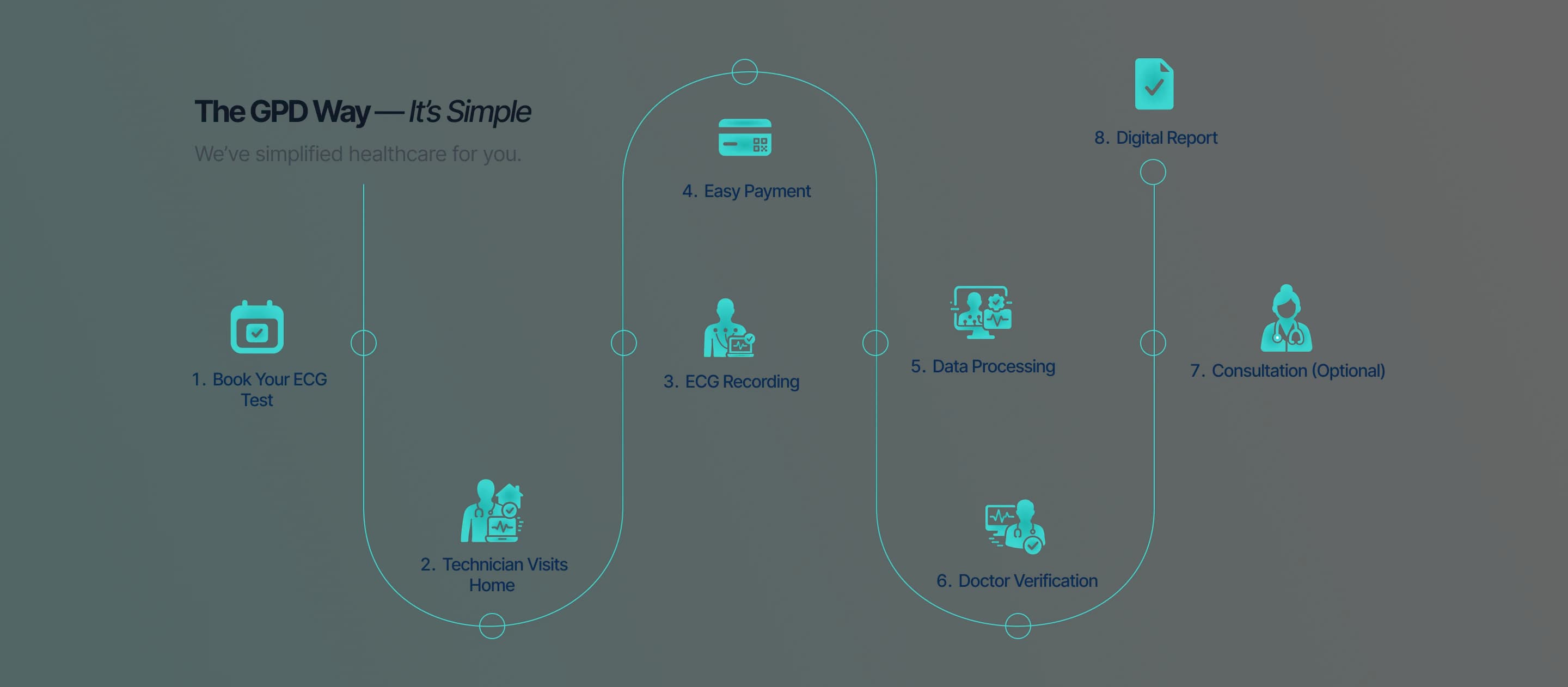
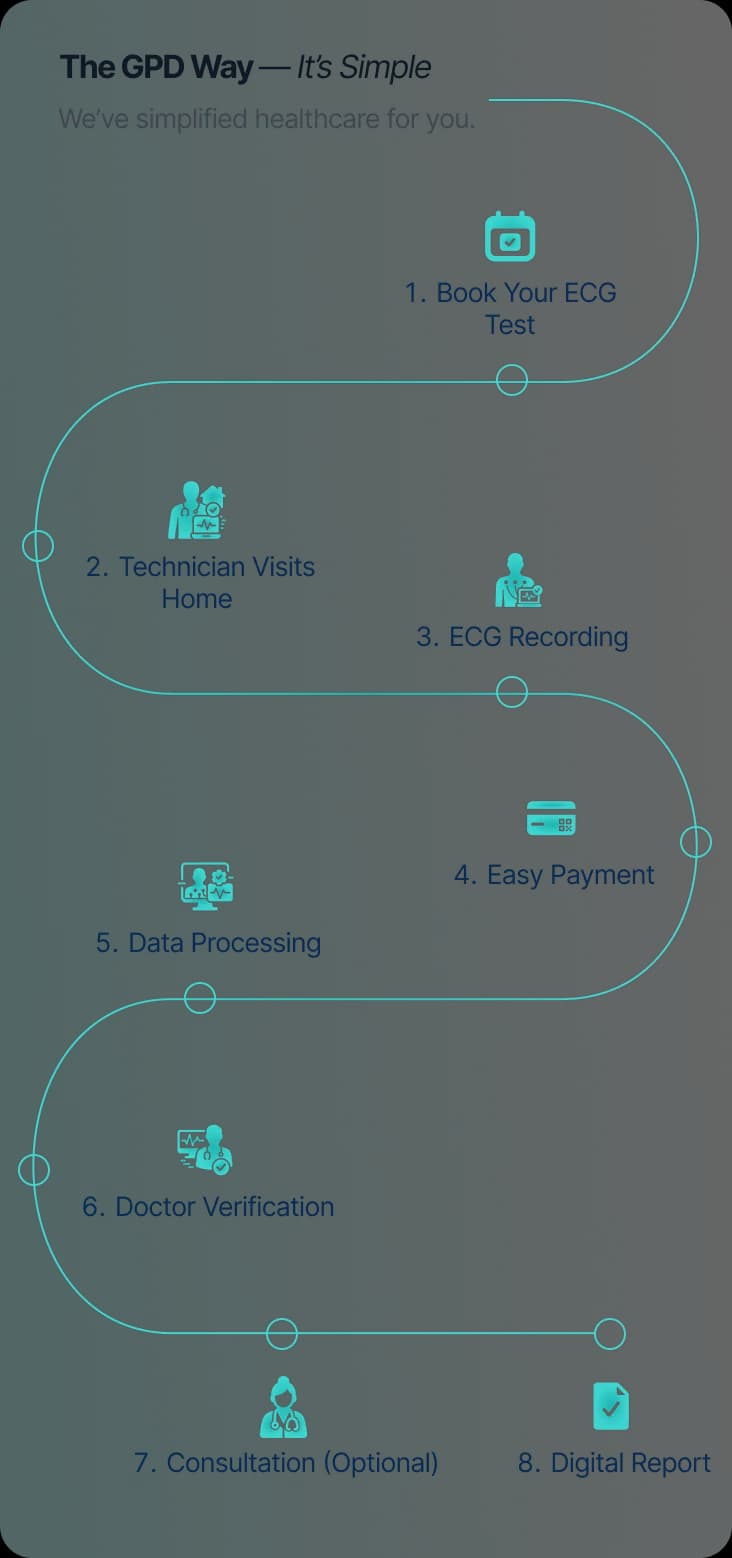
Step 1: Share the ECG Requirement
Provide the patient's details, JP Nagar location and ECG requirement when booking.
If a doctor has advised the test, keep the prescription available.
Step 2: Confirm the Appointment
The team checks the location and appointment availability.
You may also receive simple preparation guidance before the visit.
Step 3: Technician Visits the Home
A trained technician arrives with portable ECG equipment.
The patient usually lies down comfortably while the technician prepares the skin and electrode sites.
Step 4: Electrodes Are Placed
Small adhesive electrode patches are positioned on the chest and limbs.
Correct placement and good contact with the skin are important for a clear tracing.
Step 5: The ECG Is Recorded
The patient should remain relaxed and still while the machine records the heart's electrical activity.
Talking or moving during the recording can interfere with the tracing.
Step 6: Receive the Report
The current Ghar Pe Diagnostics ECG service states that the actual recording takes about 5 to 10 minutes, while the complete visit may take around 15 to 20 minutes including setup and positioning. Digital reports are shared through WhatsApp or email, typically within a few hours or on the same day.
Actual turnaround can vary, so confirm the expected reporting time when booking.
How to Prepare for ECG at Home
A routine resting ECG needs very little preparation.
Before the appointment:
- Wear loose, comfortable clothing.
- Wear clothing that allows easy access to the chest.
- Avoid applying oil, cream or lotion to the chest.
- Avoid heavy exercise just before the test.
- Keep previous ECG reports available if relevant.
- Keep a list of current medicines available.
- Tell the technician if the patient cannot lie flat comfortably.
- Stay relaxed before and during the recording.
Routine ECG usually does not require fasting.
Do not stop prescribed medicines unless your doctor has given specific instructions.
Mayo Clinic notes that a standard ECG generally needs no special preparation, although medicines should be discussed with the healthcare team.
Is ECG at Home Painful?
No. A standard ECG is non-invasive and generally painless.
There are:
- No needles
- No injections
- No electric shocks
The electrode patches simply record signals from the skin.
Some people may notice mild skin irritation or brief discomfort when the adhesive patches are removed.
Is a Home ECG Accurate?
A clinically useful ECG depends more on how the test is recorded than on whether it is performed at home or in a clinic.
Important factors include:
- Correct electrode placement
- Good electrode contact
- Minimal movement
- Clear signal quality
- Suitable ECG equipment
- Appropriate interpretation
Ghar Pe Diagnostics currently states that it uses portable medical-grade ECG machines and trained technicians for its Bangalore home ECG service.
A standard ECG still has limitations because it only captures the heart's activity during a short recording period.
Can I Use a Smartwatch or Phone Instead of a 12-Lead ECG?
Some smartwatches and personal devices can record a simple ECG-like tracing.
These devices can be useful in some situations, but they are not the same as a standard 12-lead ECG.
Personal devices usually record fewer electrical views of the heart.
They may help record certain rhythm changes, but they should not be used to rule out a heart attack or replace medical assessment when symptoms are concerning.
Mayo Clinic notes that some personal devices can perform simple ECG recordings, but patients should discuss their use with a healthcare professional.
ECG Cost at Home in JP Nagar
There is no single price that should be assumed for every home ECG visit.
The current charge may depend on the applicable service price and patient location.
Ghar Pe Diagnostics' live ECG page states that additional distance charges apply beyond the stated service radius.
Share the JP Nagar address and ECG requirement before booking so the team can confirm the current charge.
ECG Service in JP Nagar and Nearby Bengaluru Areas
Ghar Pe Diagnostics explicitly lists JP Nagar within its Bengaluru home ECG coverage.
The wider stated service network also includes:
- Jayanagar
- Banashankari
- BTM Layout
- Koramangala
- HSR Layout
Share the exact address before booking so the team can confirm availability for the requested appointment.
ECG at Home vs Hospital ECG
Both have appropriate uses.
| Factor | ECG at Home | Hospital or Clinic ECG |
|---|---|---|
| Travel | Technician comes to the patient | Patient travels to the facility |
| Best suited for | Stable, planned ECG testing | Planned testing or urgent evaluation |
| Elderly or mobility-limited patients | Can reduce travel burden | Transport is required |
| Standard 12-lead ECG | Can be recorded with portable equipment | Routinely available |
| Emergency treatment | Not available as part of planned home ECG | Emergency care can be provided |
| Additional urgent tests | Limited | Blood tests, imaging and treatment may be immediately available |
Choose home ECG when the patient is stable and the test is planned.
Choose hospital or emergency care when symptoms may require immediate medical treatment.
When Should You Not Wait for ECG at Home?
Home ECG is not an emergency service.
Seek urgent medical care if there is:
- Severe or persistent chest pain
- Chest pressure or tightness with sweating
- Pain spreading to the arm, jaw, shoulder or back
- Severe breathlessness
- Fainting
- Collapse
- Sudden confusion
- Sudden weakness on one side of the body
- A very fast or very slow heartbeat with severe symptoms
- Rapidly worsening symptoms
Do not wait for a technician to arrive in these situations.
A home ECG is intended for stable, planned assessment and follow-up.
Book ECG at Home in JP Nagar
If a doctor has advised an ECG and the patient is medically stable, Ghar Pe Diagnostics can help arrange a 12-lead ECG at home in JP Nagar.
Keep the ECG requirement or prescription ready and share the patient's location when making an enquiry.
Contact Ghar Pe Diagnostics to confirm current availability, applicable charges and expected report timing.
You Rest, We Test.