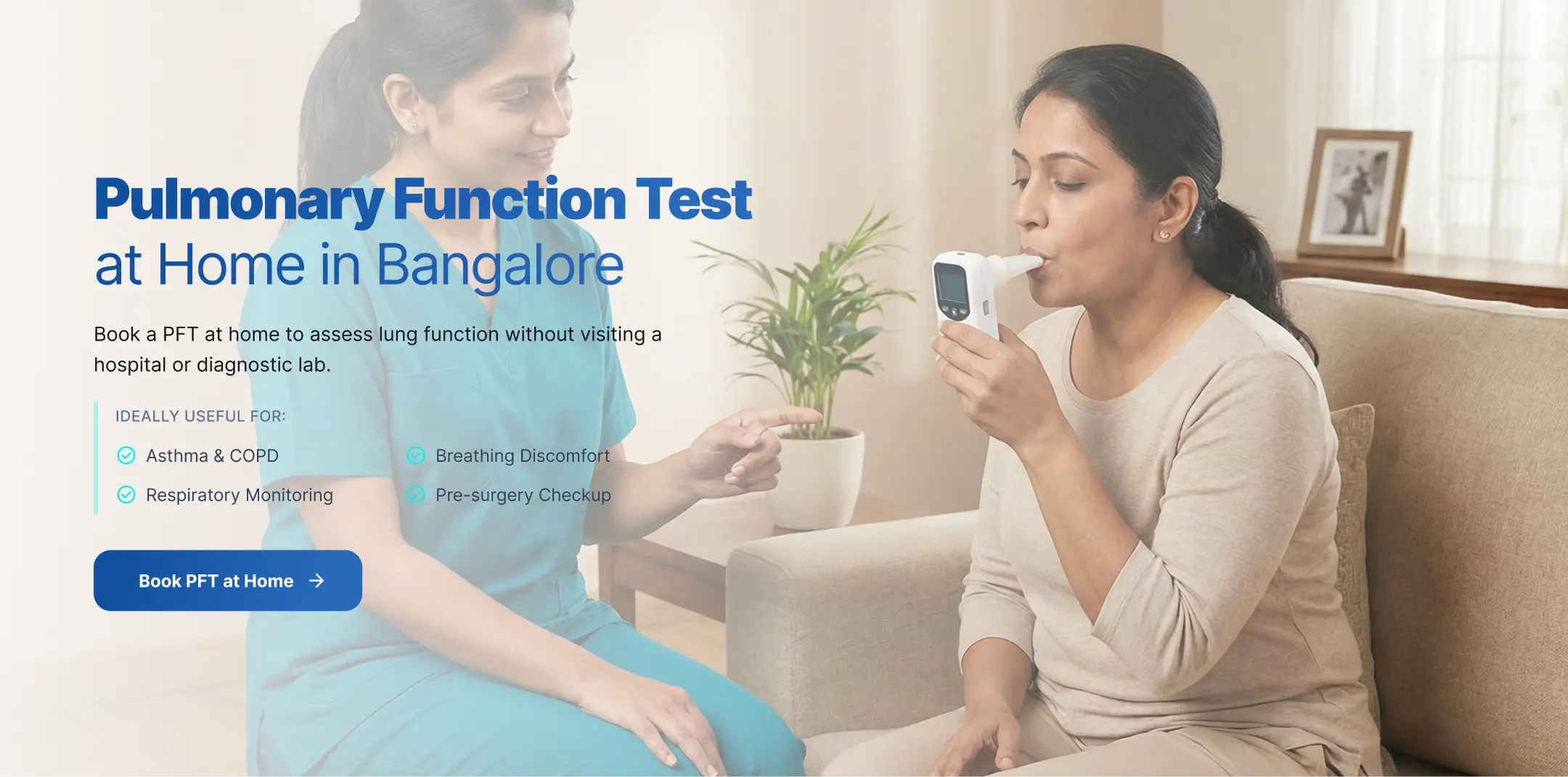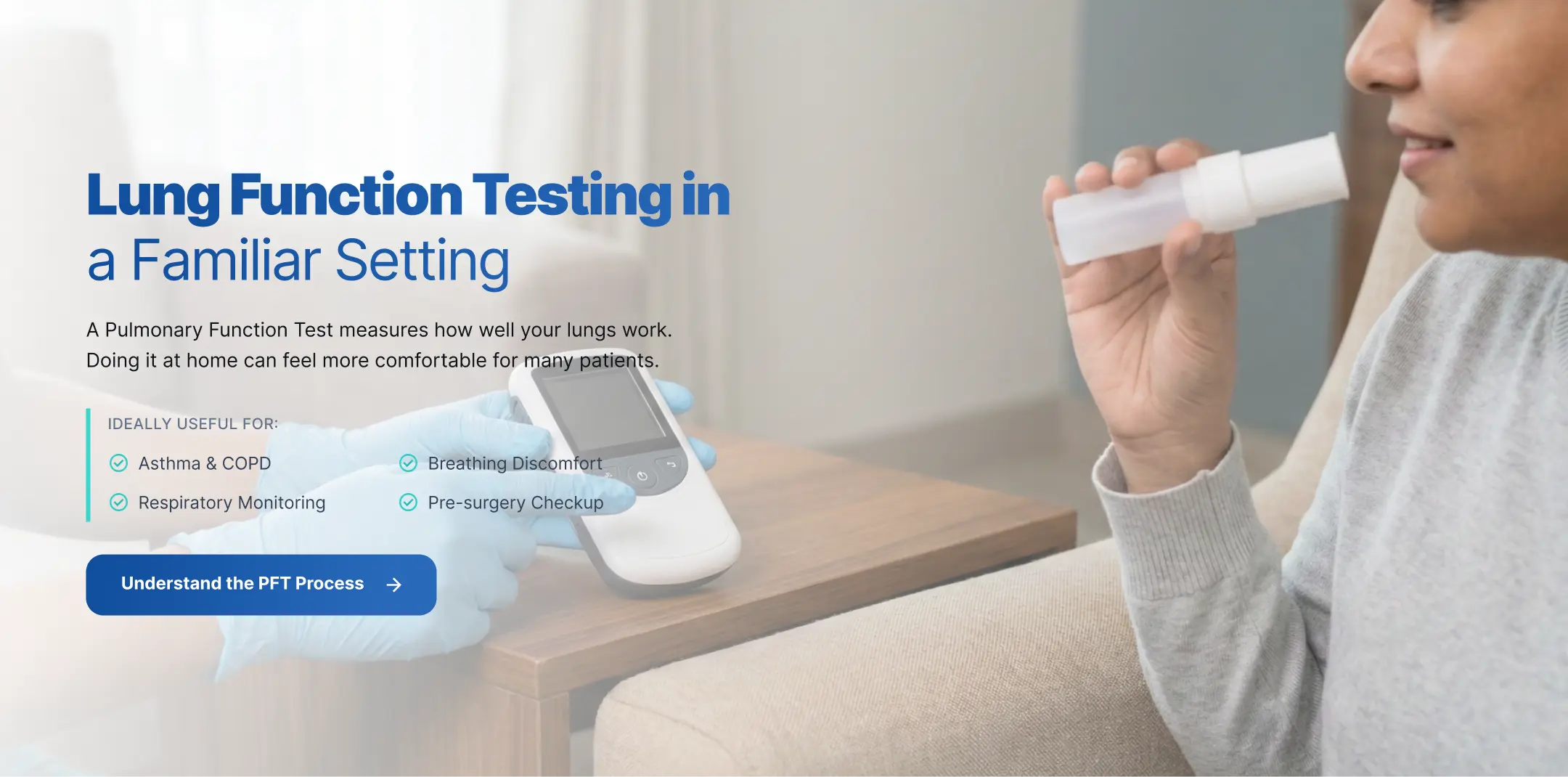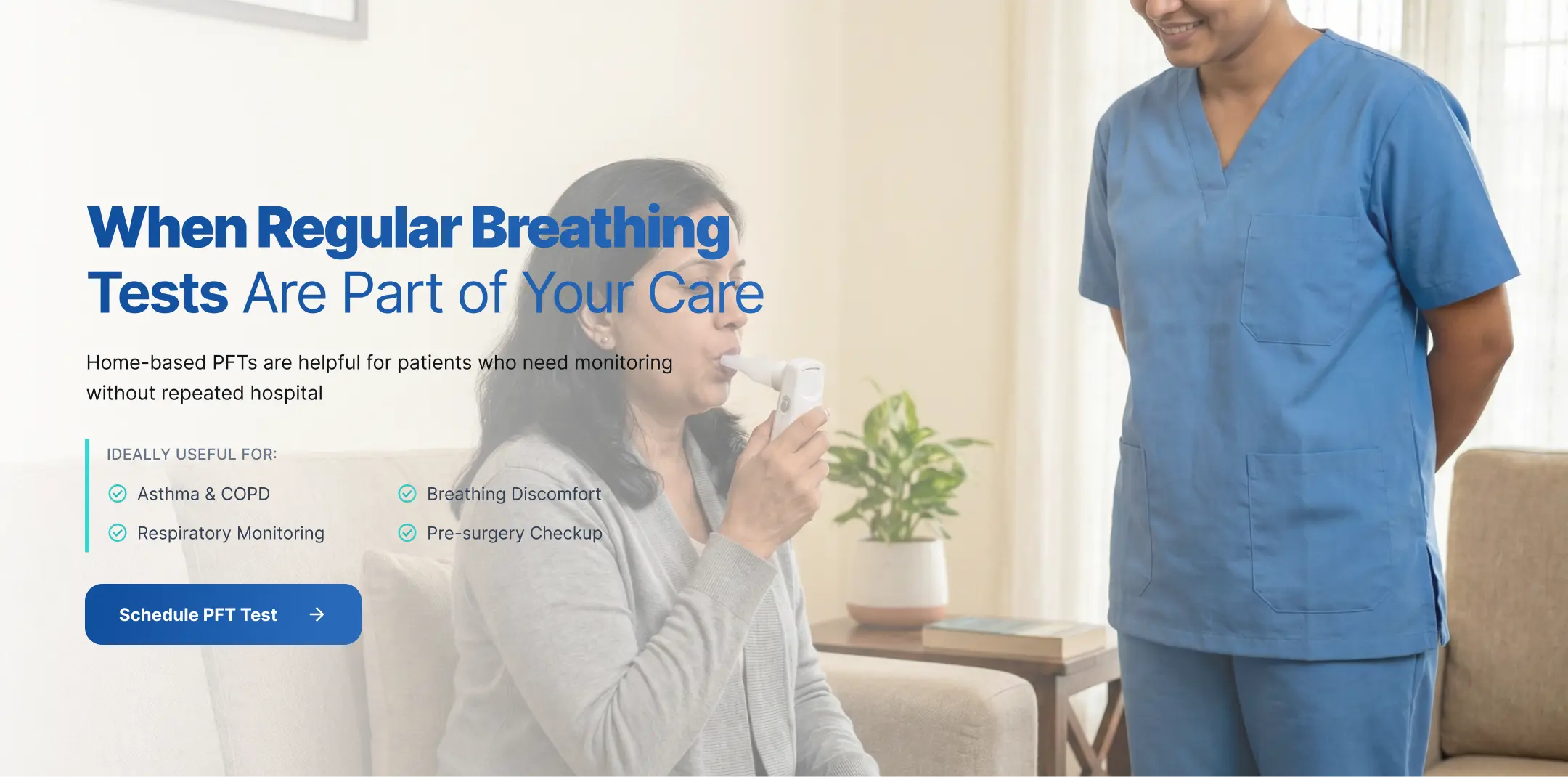
A PFT test helps doctors monitor asthma and COPD by measuring how well air moves in and out of your lungs, so they can see whether your condition is stable, improving or getting worse, and whether your inhalers are working. Ghar Pe Diagnostics (GPD) does PFT at home across Bangalore, which makes regular follow-up much easier for people who get breathless travelling to a hospital. A trained respiratory technician does the test in about 20 to 30 minutes, a qualified specialist interprets it, and the report usually arrives within 12 to 24 hours.
Why Symptoms Alone Are Not Enough
With asthma and COPD, how you feel does not always match how your lungs are doing. Some people get used to a slow decline and do not notice it. Others feel very breathless with only a small change in their airways. A PFT puts numbers on it, so treatment decisions are based on measurement, not guesswork.
Asthma vs COPD: What PFT Looks For
| Asthma | COPD | |
|---|---|---|
| Usual pattern | Symptoms come and go, often with triggers | Symptoms build up slowly and tend to persist |
| Common triggers or causes | Dust, pollen, cold air, exercise, infections | Smoking, long-term exposure to smoke, dust or fumes |
| What PFT shows | Airway narrowing that often improves after a reliever inhaler | Airflow obstruction that does not fully reverse |
| What monitoring tracks | How well controlled the asthma is on current treatment | How fast lung function is changing and how treatment is helping |
Some people have features of both. Your doctor reads the PFT together with your symptoms, history and examination.
The Numbers Your Doctor Tracks
- FEV1: how much air you blow out in the first second. The main number for tracking asthma and COPD over time.
- FVC: the total air you can blow out after a full breath.
- FEV1/FVC ratio: shows whether airflow is obstructed.
- Peak flow: the fastest speed of your breath out.
The real value comes from comparing reports over time, so always keep your old PFT reports and share them with the technician and your doctor.
When Doctors Usually Repeat a PFT
- When symptoms are getting worse or more frequent
- After a change in inhalers or medicines, to see if it helped
- After a flare-up or hospital stay, once you are stable
- At regular follow-up intervals your doctor sets
- Before a planned surgery
There is no fixed rule that fits everyone. Follow your doctor's plan. Repeating a PFT without a clear reason does not add much.
Is Your Asthma or COPD Under Control? Warning Signs
- Using your reliever inhaler more often than before
- Waking up at night with cough or breathlessness
- Getting breathless doing things you managed easily a few months ago
- More cough or more mucus than usual
- Chest infections that keep coming back
If you notice these, talk to your doctor. A PFT is often part of that review.
Why Home PFT Helps with Regular Monitoring
- No tiring trip before the test. PFT depends on effort. Arriving exhausted after traffic can pull your numbers down.
- Easier to keep to the schedule. Follow-ups are less likely to be skipped when the test comes to you.
- Less exposure to infections. Chest infections are a common trigger for flare-ups, and home testing keeps you out of crowded waiting rooms.
- Same comfortable setting each time, which helps you give your best effort.
Preparing for a Monitoring PFT
- Ask your doctor whether to take your usual inhaler before the test, and tell the booking team
- Do not stop any medicine on your own
- Avoid a heavy meal for 2 to 3 hours before the test
- Do not smoke before the appointment
- Wear loose clothing and keep old PFT reports ready
Do Not Test During a Flare-Up
A home PFT is for when you are stable or only mildly unwell. If you are very breathless, cannot finish a sentence, have bluish lips or fingers, feel confused or your oxygen is falling, go to the nearest hospital straight away.
Other Tests Your Doctor May Add
For COPD or a chest infection, doctors sometimes add a chest X-Ray. For breathlessness that may involve the heart, they may add an ECG. GPD offers X-Ray at home and ECG at home as separate bookings, and lab tests at home for blood tests your doctor asks for.
Book PFT for Asthma or COPD Monitoring
PFT at home is currently listed at ₹750, with a free visit within 5 km of our branch. Book on the PFT booking page or call or WhatsApp +91 9611508886, 8 AM to 8 PM, all 7 days. For the full service overview, see PFT test at home in Bangalore. GPD covers Jayanagar, JP Nagar, Banashankari, BTM Layout, HSR Layout, Whitefield and more.