


Ghar Pe Diagnostics provides X-Ray at home in JP Nagar for patients who need doctor-advised portable imaging without travelling to a diagnostic centre. A trained technician visits the patient's home with portable digital X-Ray equipment and performs the prescribed scan when the required view and patient positioning are suitable for a home setup.
Home X-Ray can be especially practical for elderly patients, bedridden patients, people recovering after surgery, patients with limited mobility and those who need follow-up chest, bone or joint imaging. Families who need other investigations can also explore the broader range of home diagnostic services in Bangalore.
What Is X-Ray at Home?
X-Ray at home is a doorstep imaging service in which portable digital X-Ray equipment is brought to the patient's residence.
Instead of travelling to a diagnostic facility, the patient can undergo the prescribed scan at home when the required body part and X-Ray view can be positioned safely.
Doctors commonly use X-Ray imaging to assess bones, selected joints, the chest and certain structural changes.
Home imaging can be particularly useful when pain, weakness, age, surgery or reduced mobility makes travelling difficult.
For information about the service across Bengaluru, patients can also review X-Ray at home in Bangalore.
Why Book X-Ray at Home in JP Nagar?
JP Nagar has access to hospitals and diagnostic centres, but reaching them can still be difficult for an elderly, injured, bedridden or recently discharged patient.
A portable home X-Ray reduces the need to move a medically stable patient for a suitable doctor-prescribed examination.
Patients in JP Nagar may need home X-Ray for:
Chest X-Ray
Suspected bone fracture
Pain after a fall
Selected knee, shoulder, wrist, hip or limb imaging
Joint or bone pain
Post-surgery follow-up
Elderly patient imaging
Bedridden patient imaging
Doctor-advised repeat imaging
The suitability of home X-Ray depends on the prescription, patient's condition, required X-Ray view, available space and ability to position the patient safely.
Why Choose Ghar Pe Diagnostics for Portable X-Ray?
Ghar Pe Diagnostics provides a broader range of home diagnostic services across Bengaluru rather than limiting doorstep testing to sample collection.
For X-Ray patients in JP Nagar, portable imaging can reduce unnecessary movement when the prescribed examination is suitable for a home environment.
Home X-Ray does not replace hospital imaging when a patient requires emergency care, advanced imaging or a complex view that cannot be completed safely at home.
Who May Need X-Ray at Home in JP Nagar?
A home X-Ray may be appropriate when a doctor has advised imaging and the patient is medically stable but finds travelling difficult.
It may be practical for:
Senior citizens with reduced mobility
Bedridden patients
Patients recovering after surgery
People with suspected uncomplicated fractures
Patients with pain or swelling after an injury
People advised to undergo a chest X-Ray
Patients with joint or bone pain
Homebound patients needing follow-up imaging
People who find sitting, standing or travelling difficult
If the patient has major trauma, severe breathlessness, uncontrolled bleeding, loss of consciousness or rapidly worsening symptoms, urgent hospital evaluation should not be delayed.
Chest X-Ray at Home in JP Nagar
Chest X-Ray is one of the common portable imaging requirements.
Doctors may request a chest X-Ray when they need to evaluate or monitor the lungs, chest structures or changes related to respiratory illness.
A chest X-Ray may form part of the assessment or follow-up for:
Persistent cough
Chest congestion
Suspected respiratory infection
Pneumonia follow-up
Breathing-related symptoms
Post-infection review
Selected pre-operative assessment
Other doctor-advised chest concerns
A chest X-Ray cannot identify the cause of every respiratory or chest symptom.
Depending on the clinical question, a doctor may also recommend a PFT test at home to assess lung function, an ECG at home to record heart electrical activity, blood investigations or hospital-based imaging.
Severe chest pain, collapse, fainting or severe breathlessness requires urgent medical evaluation rather than waiting for a planned home test.
Elderly X-Ray at Home in JP Nagar
Older adults may need imaging after a fall, for new bone or joint pain, for chest symptoms or during post-treatment follow-up.
For families caring for elderly patients, even a short diagnostic-centre visit may involve arranging transport, wheelchair support, caregivers and repeated patient movement.
When the required scan is suitable for portable imaging, completing the X-Ray at home can reduce this logistical burden.
Common doctor-advised requirements may include:
Hip-area imaging where positioning is possible
Knee X-Ray
Wrist or hand X-Ray
Shoulder X-Ray
Chest X-Ray
Selected spine imaging
Post-operative review
If an elderly patient needs a clinical examination before the family knows which investigation is appropriate, they can explore a doctor visit at home.
A medically unstable patient may still need hospital care even when travelling is difficult.
Post-Surgery X-Ray at Home in JP Nagar
Doctors sometimes request repeat X-Ray imaging after orthopaedic treatment, fracture fixation or surgery.
Depending on the procedure, follow-up imaging may help the treating clinician review:
Bone healing
Alignment
Implant or hardware position
Progress after fracture treatment
Other post-operative findings visible on X-Ray
A portable X-Ray may make follow-up easier for a patient who still has mobility restrictions, provided the required view can be obtained safely.
Keep the doctor's prescription and previous imaging available when possible.
The treating doctor should review the new report together with the patient's symptoms, examination and recovery progress.
X-Ray Cost at Home in JP Nagar
There is no single price for every home X-Ray.
The final charge can vary according to factors such as:
Body part being examined
X-Ray view requested
Number of views where applicable
Patient location
Distance involved in the home visit
Specific imaging requirement
The current Ghar Pe Diagnostics X-Ray service page states that additional distance charges may apply beyond the applicable service radius.
Share the prescription and JP Nagar address before booking so the team can confirm the current charge for the required examination.
The imaging test should follow the doctor's recommendation rather than being selected only on the basis of price.
How X-Ray at Home Works in JP Nagar
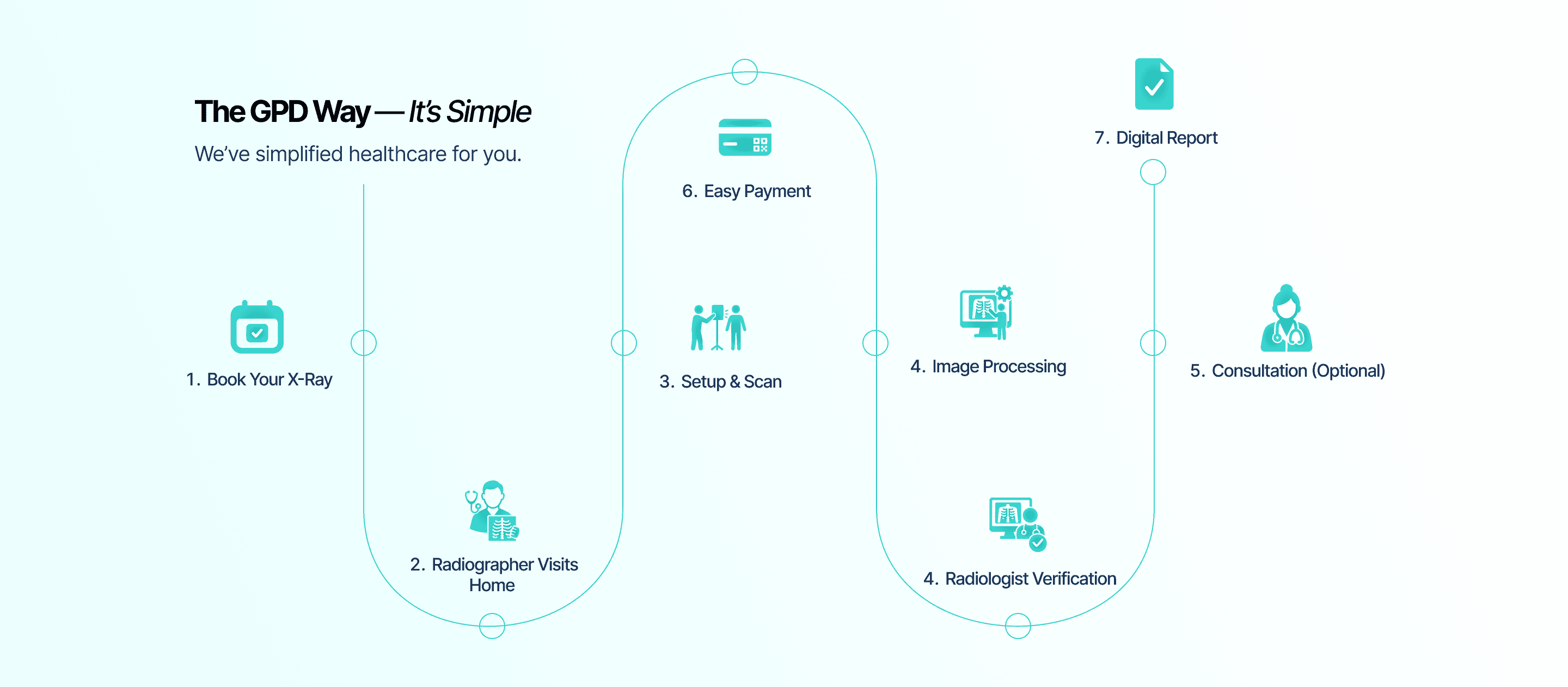
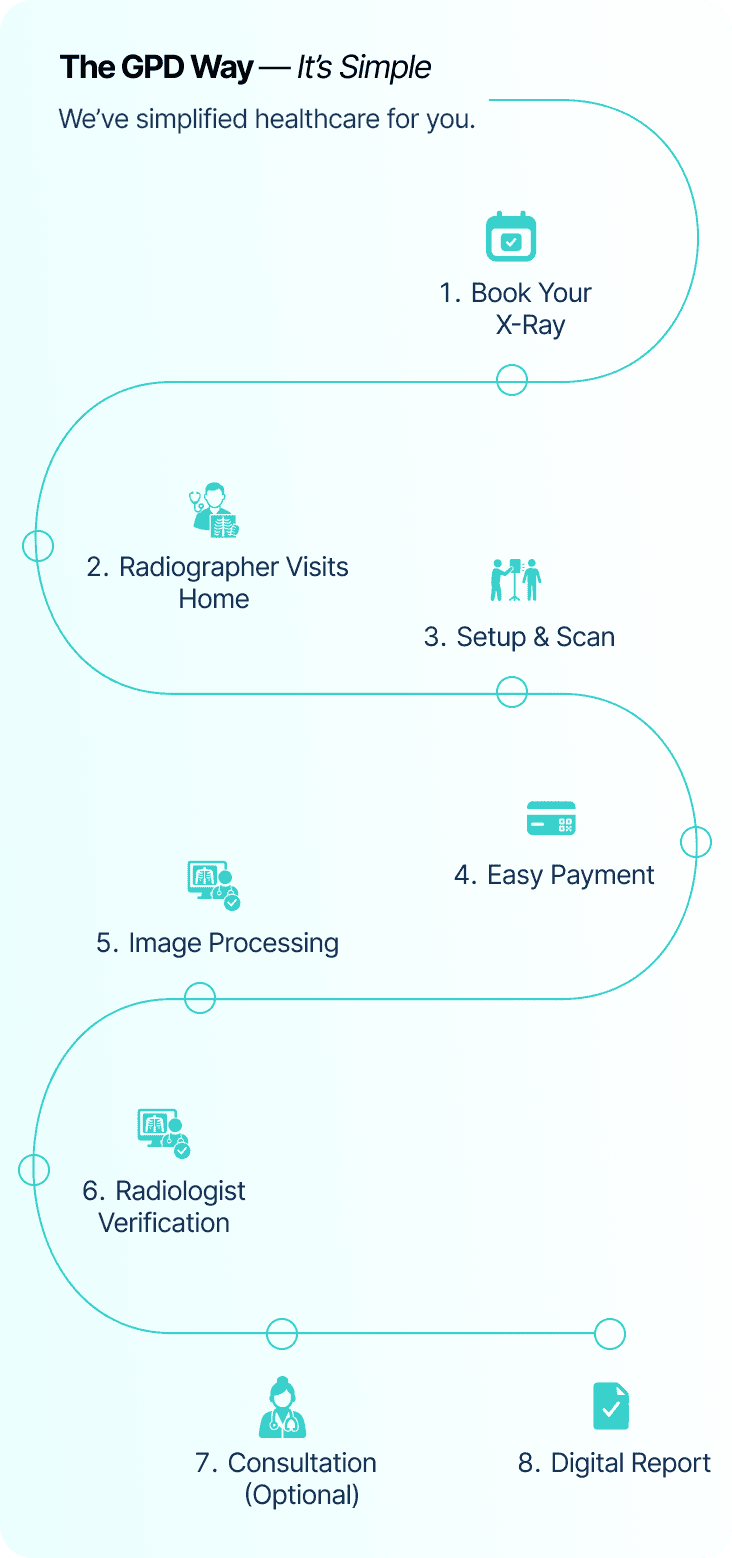
Step 1: Share the Prescription
Keep the doctor's prescription or exact X-Ray requirement ready.
The prescription helps the team identify the required body part and view before confirming whether portable imaging is suitable.
Step 2: Share Your JP Nagar Location and Patient Details
Provide the patient's location and relevant practical information such as:
Patient age
Body part to be scanned
Mobility limitations
Recent surgery or injury
Whether the patient is bedridden
Difficulty sitting, standing or turning
This information helps the team assess the practical requirements of the home visit.
Step 3: Confirm the Appointment
The team checks the requested X-Ray, location and technician availability before confirming the visit.
Availability can vary according to the test requirement and appointment schedule.
Step 4: Technician Performs the X-Ray
A trained technician arrives with portable digital X-Ray equipment.
The technician checks the available space, positions the patient according to the prescribed view and performs the required exposure.
Step 5: Images Go for Reporting
The digital images enter the applicable radiologist reporting workflow.
The current X-Ray at home service states that reports are typically available within 12 to 24 hours.
Actual turnaround can vary depending on the examination and reporting workflow.
Patients can then share the completed report with the doctor who requested the scan.
How to Prepare for X-Ray at Home
Most standard X-Rays require little preparation.
Before the technician arrives:
Keep the doctor's prescription ready.
Confirm the body part and side mentioned on the prescription.
Wear loose, comfortable clothing when possible.
Remove jewellery or metal objects near the scan area when instructed.
Keep previous X-Ray reports available for follow-up imaging.
Inform the team if the patient is bedridden.
Make suitable space near the patient's bed or chair where possible.
Tell the technician if moving the patient causes significant pain.
Inform the team if pregnancy is possible or confirmed.
Do not force a patient into a painful position. The technician can assess whether the prescribed view can be captured safely at home.
Is Portable X-Ray at Home Safe?
X-Ray uses ionising radiation, so it should be performed only when clinically appropriate.
During a portable home X-Ray, the technician follows positioning and radiation-safety procedures for the prescribed examination.
Patients and family members should follow the technician's instructions about where to remain during the exposure.
Safety considerations include:
Imaging only the prescribed body part and view
Correct positioning of the equipment
Keeping unnecessary people away during exposure
Avoiding unnecessary repeat exposures
Informing the technician if pregnancy is possible
Portable X-Ray should not be treated as routine imaging without a clinical reason.
What Can an X-Ray Help Doctors Assess?
X-Ray provides particularly useful images of bones and can also show selected chest and structural findings.
Depending on the prescribed examination, it may help doctors assess:
Bone fractures
Bone alignment
Selected joint changes
Some chest findings
Post-operative bone healing
Implant or hardware position
Certain spine abnormalities
An X-Ray does not show every type of injury or disease.
It usually provides limited information about:
Ligament tears
Tendon injuries
Many soft-tissue problems
Detailed abdominal organs
Many neurological conditions
A doctor may recommend CT, MRI, ultrasound, blood tests at home or another investigation when an X-Ray cannot answer the clinical question.
Can X-Ray Detect Torn Ligaments?
Usually not directly.
Ligaments are soft tissues and do not appear clearly on a standard X-Ray. However, a doctor may still request an X-Ray after an injury to check for:
Fractures
Bone injury
Joint alignment problems
Dislocation
When a ligament injury is suspected, further evaluation may include physical examination, MRI, ultrasound in selected cases or an orthopaedic consultation.
Severe swelling, deformity, inability to bear weight or intense pain after an injury requires appropriate medical assessment.
Can Tumours Be Seen on an X-Ray?
Some abnormal masses or bone changes may be visible on certain X-Ray images, but an X-Ray cannot reliably identify or confirm every tumour.
If a doctor suspects a tumour, additional investigation may include:
CT imaging
MRI
Ultrasound
Blood tests
Biopsy
Specialist evaluation
An X-Ray result should therefore be interpreted together with the patient's symptoms, medical history and other investigations.
Can an X-Ray Show Spleen Problems?
A standard X-Ray provides limited information about the spleen.
When a doctor needs to assess suspected spleen enlargement, injury or another spleen-related concern, they may recommend ultrasound, CT imaging, blood investigations or another appropriate test.
Severe abdominal pain after trauma, dizziness, collapse or signs of significant internal injury require urgent medical evaluation.
Can X-Ray Be Done at Home?
Yes.
Portable digital equipment makes it possible to perform many common X-Ray examinations in a patient's home when the required view and patient positioning are suitable.
Home X-Ray may be considered for:
Elderly patients
Bedridden patients
Post-surgery follow-up
Selected chest imaging
Limb and bone imaging
Doctor-advised repeat X-Ray
Some examinations still require a diagnostic centre or hospital because of complex positioning, advanced imaging requirements or the patient's medical condition.
X-Ray Service Around JP Nagar
Ghar Pe Diagnostics lists JP Nagar within its Bengaluru home diagnostic service coverage.
The wider stated service network also includes nearby South Bengaluru areas such as:
Jayanagar
BTM Layout
Banashankari
Basavanagudi
Coverage and appointment availability should be confirmed for the exact address and required X-Ray before booking.
Do not assume that every X-Ray view can be completed at every residence. The prescription, patient positioning and available space can affect feasibility.
X-Ray at Home vs Diagnostic Centre X-Ray
Both home and facility-based imaging have appropriate uses.
Home X-Ray is generally suited to planned, doctor-advised imaging when the patient is medically stable.
A hospital or diagnostic centre is more appropriate when the patient may need urgent treatment, advanced imaging such as CT or MRI, or an examination that cannot be performed safely with portable equipment.
When Should You Not Wait for Home X-Ray?
Home X-Ray should not delay emergency medical care.
Seek urgent evaluation for:
Major accident or serious trauma
Severe or worsening chest pain
Severe breathing difficulty
Loss of consciousness
Significant head injury with concerning symptoms
Uncontrolled bleeding
Open fracture
Severe limb deformity
Severe abdominal pain after trauma
Sudden stroke-like symptoms
A rapidly worsening medical condition
In these situations, go to an appropriate emergency facility rather than waiting for doorstep imaging.
Book X-Ray at Home in JP Nagar
If a doctor has advised an X-Ray and travelling to a diagnostic centre is difficult, Ghar Pe Diagnostics can help you check whether the prescribed scan is suitable for a home visit in JP Nagar.
Keep the prescription ready and share the body part, patient condition and exact location when making an enquiry.
Contact Ghar Pe Diagnostics to confirm the X-Ray requirement, current availability and applicable charges.
You Rest, We Test.