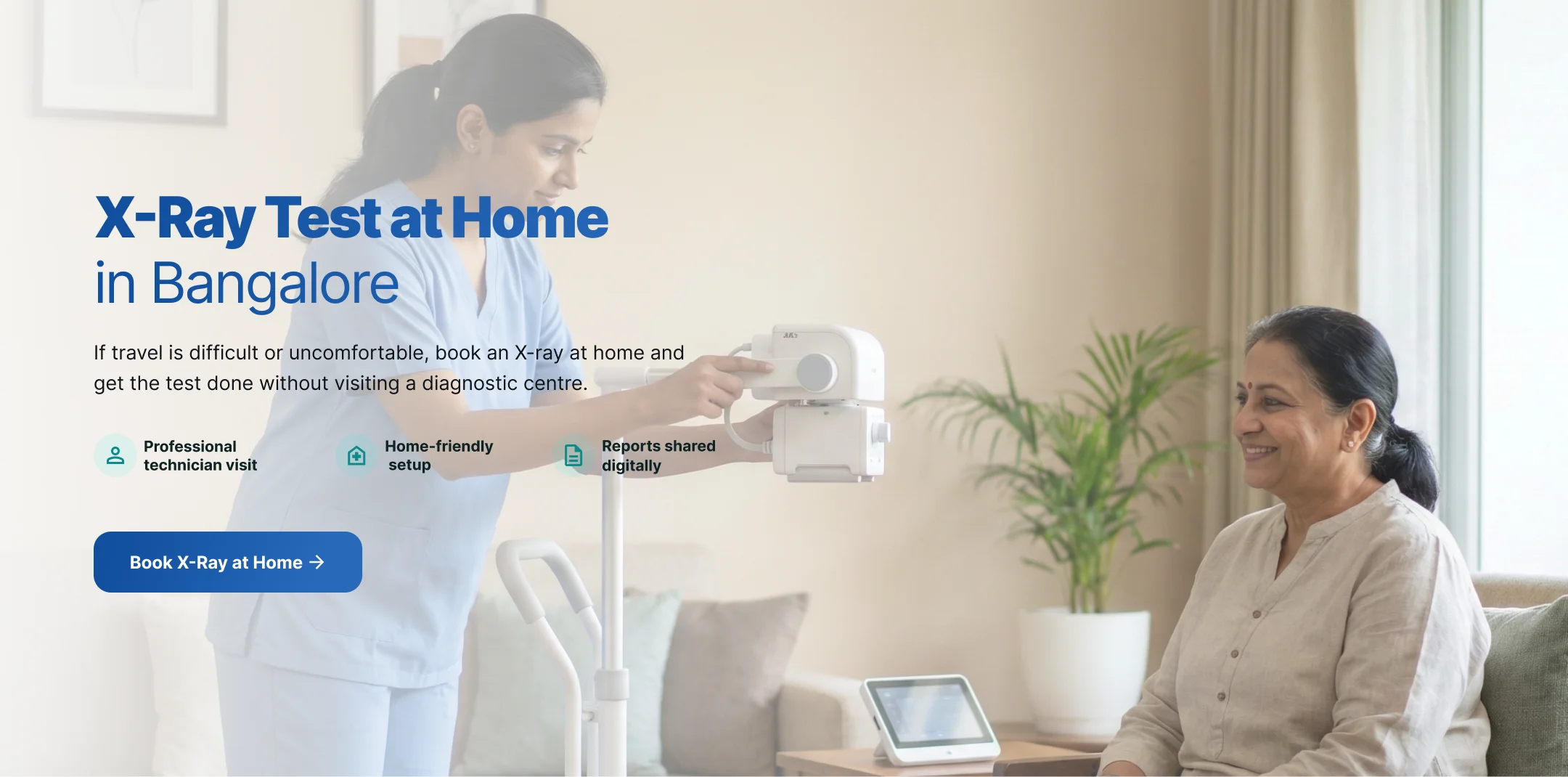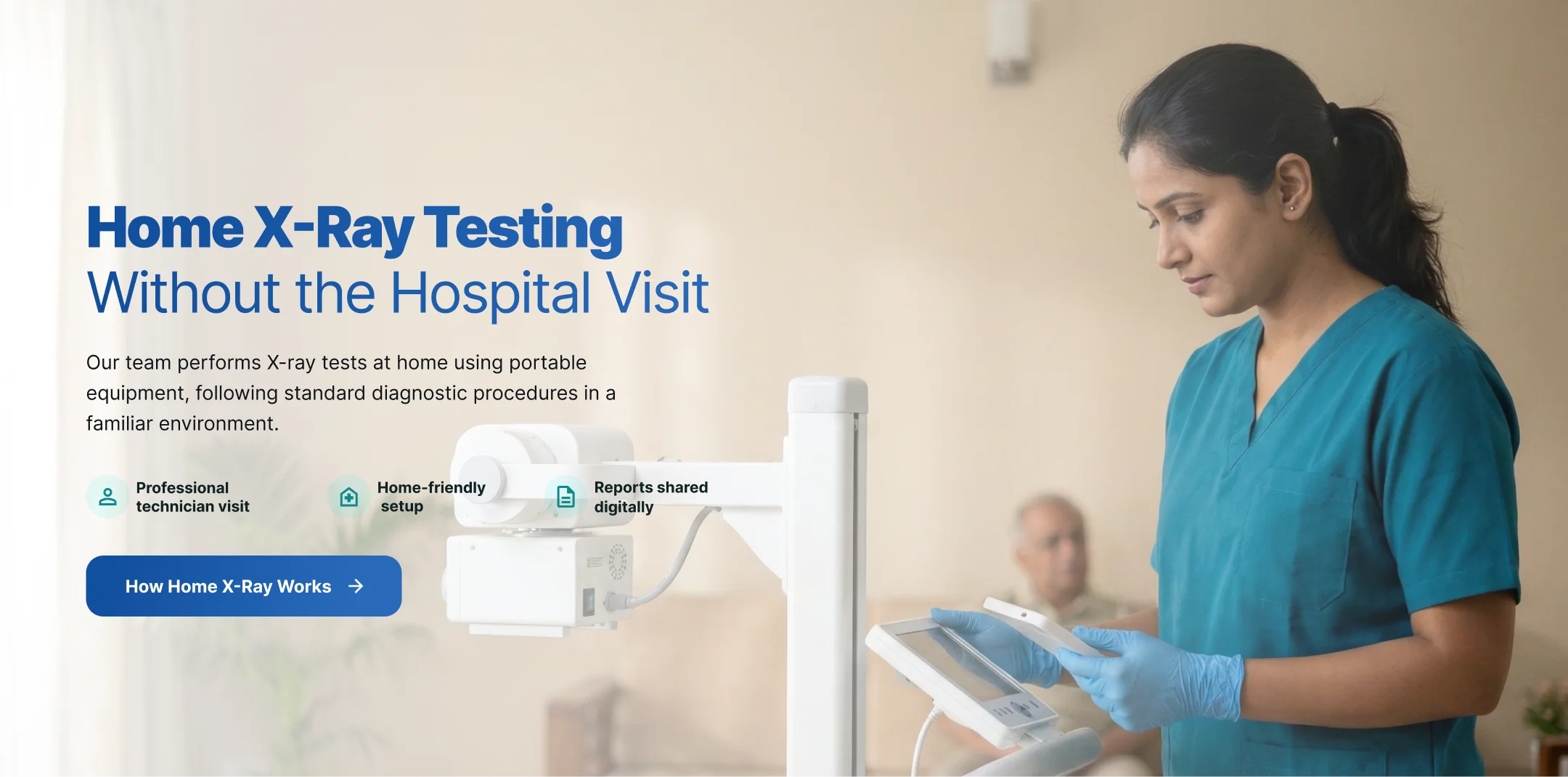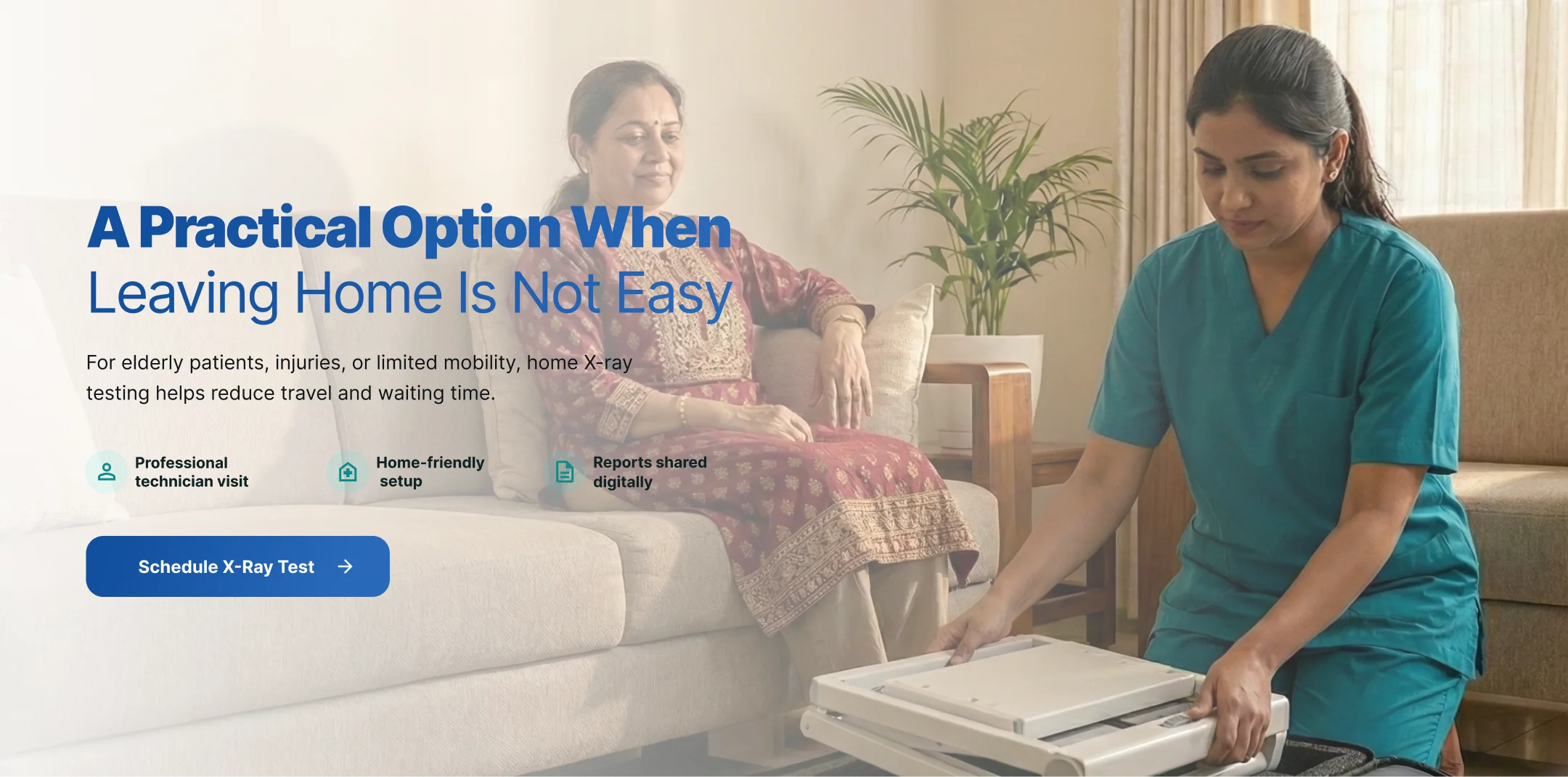

An X-Ray at home is needed when a doctor has advised an X-Ray and taking the patient to a diagnostic centre is painful, risky or simply not practical. The most common cases are elderly patients after a fall, bedridden patients, people recovering from surgery and patients who are too unwell to travel. Ghar Pe Diagnostics (GPD) sends a certified technician with a portable digital X-Ray machine to homes across Bangalore, and the radiologist report usually arrives on WhatsApp or email within 12 to 24 hours.
This guide helps you decide whether a home X-Ray is the right choice, or whether the patient should go to a hospital.
Quick Check: Home X-Ray or Hospital?
| Situation | Home X-Ray | Hospital or centre |
|---|---|---|
| Elderly patient with pain after a minor fall | Usually a good fit | Tiring, often needs a wheelchair |
| Bedridden or on home oxygen | Often possible at the bedside | Needs ambulance or stretcher support |
| Follow-up X-Ray after fracture or surgery | Good fit if the doctor only needs imaging | Also suitable |
| Cough or chest infection follow-up | Good fit | Also suitable |
| Contrast study, CT or MRI | Not possible | Needed |
| Major accident, head injury or deformed limb | Not suitable | Go to emergency now |
| Doctor expects treatment right after the scan | Not suitable | Hospital is better |
Situations Where Home X-Ray Helps Most
After a fall at home
A slip in the bathroom or a fall from the bed often leaves pain and swelling in the wrist, hip, knee or back. If the patient is stable, a home X-Ray lets the doctor check for a fracture without the pain of getting the patient into a car.
Recovery after surgery
Orthopaedic surgeons often ask for repeat X-Rays to check how a fracture is healing or whether a plate, screw or joint implant is in place. When the patient can barely walk, a home X-Ray saves a hard trip for what is only a picture.
Bedridden and home care patients
For patients on long-term bed rest, home oxygen or palliative care, even a short trip carries risk. Many X-Rays, especially chest and limb views, can be taken at the bedside once the team confirms the room setup.
Chest symptoms that need imaging
A cough that will not settle, fever with breathlessness or follow-up after pneumonia often need a chest X-Ray. Doing it at home keeps a weak patient away from a crowded waiting room.
Mobility limits and travel difficulty
No lift in the building, no one free to take the patient, or a patient who needs a wheelchair all make a centre visit hard. A home visit removes those problems.
Which X-Rays Can Be Done at Home?
GPD commonly does these X-Rays at home in Bangalore:
- Chest and ribs
- Shoulder, elbow, forearm, wrist, hand and fingers
- Hip, knee, leg, ankle and foot
- Neck, upper back and lower back (spine), if positioning is possible
- Pelvis, skull and abdomen (KUB)
Whether a view can be done depends on the room space and how safely the patient can be positioned. Contrast studies, very complex views, CT and MRI still need a hospital or imaging centre.
What an X-Ray Can and Cannot Show
An X-Ray is good at showing bones, joint alignment, the lungs and metal implants. It is not good at showing soft tissue.
- Torn ligaments: not visible directly. An X-Ray can rule out a broken bone after a twist, but doctors usually need an MRI for the ligament.
- Tumours: some may show up, but an X-Ray cannot confirm cancer. CT, MRI or a biopsy is needed.
- Spleen and most abdominal organs: an ultrasound or CT is the usual test.
Knowing this helps you avoid booking a home X-Ray when the doctor really needs a different scan.
When Not to Wait for a Home X-Ray
Go straight to the nearest emergency department if the patient has:
- A major accident or a fall from height
- A head injury, confusion, vomiting or loss of consciousness
- A visibly deformed limb or bone pushing through the skin
- Bleeding that will not stop
- Severe chest pain or severe breathlessness
- Sudden weakness on one side of the body
How to Book an X-Ray at Home
- Choose the X-Ray on the X-Ray booking page, or upload the prescription if you are unsure of the view.
- Tell the team whether the patient can stand, sit or only lie down, and mention any implants, plates or pregnancy.
- Confirm the slot and any distance charge. The visit is free within 5 km of our branch.
- The technician sets up the machine, and the scan takes about 15 to 20 minutes.
- The radiologist report reaches you on WhatsApp or email, usually within 12 to 24 hours.
Chest X-Ray is currently listed at ₹2000 and most other views at ₹1500. For the full service overview and safety details, read our guide to X-Ray at home in Bangalore. GPD covers areas such as Jayanagar, JP Nagar, Banashankari, BTM Layout, HSR Layout and Whitefield.
Book X-Ray at Home in Bangalore
If a home X-Ray fits your situation, book X-Ray at home with Ghar Pe Diagnostics or call or WhatsApp +91 9611508886, 8 AM to 8 PM, all 7 days.