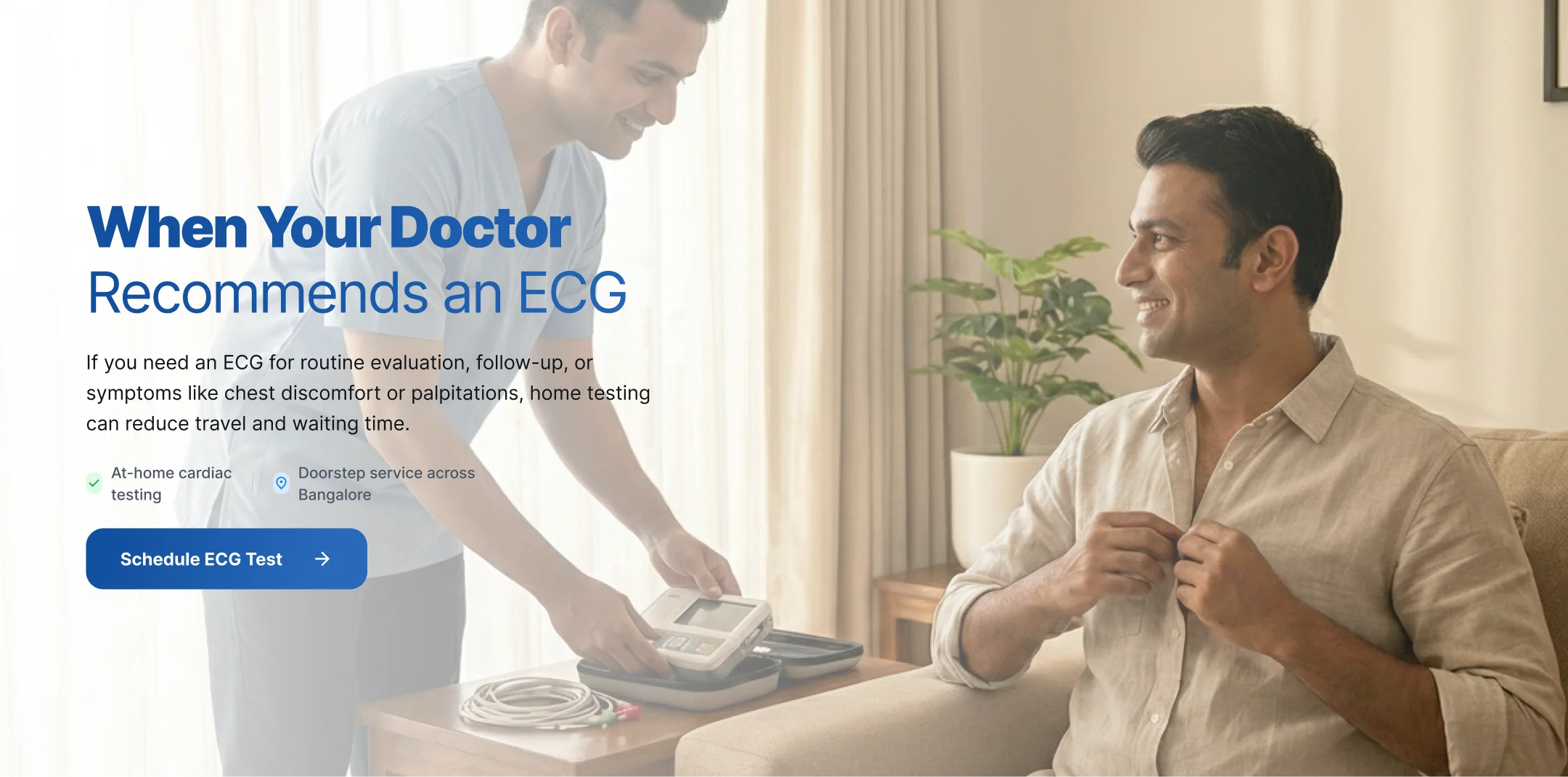
You should book an ECG at home when your doctor has asked for one and the situation is stable and planned. Typical cases are palpitations that come and go, a pre-surgery check, follow-up after hospital discharge or heart treatment, and regular heart monitoring for people with high blood pressure or diabetes. You should not book a home ECG for sudden or severe chest pain. That needs a hospital, right away.
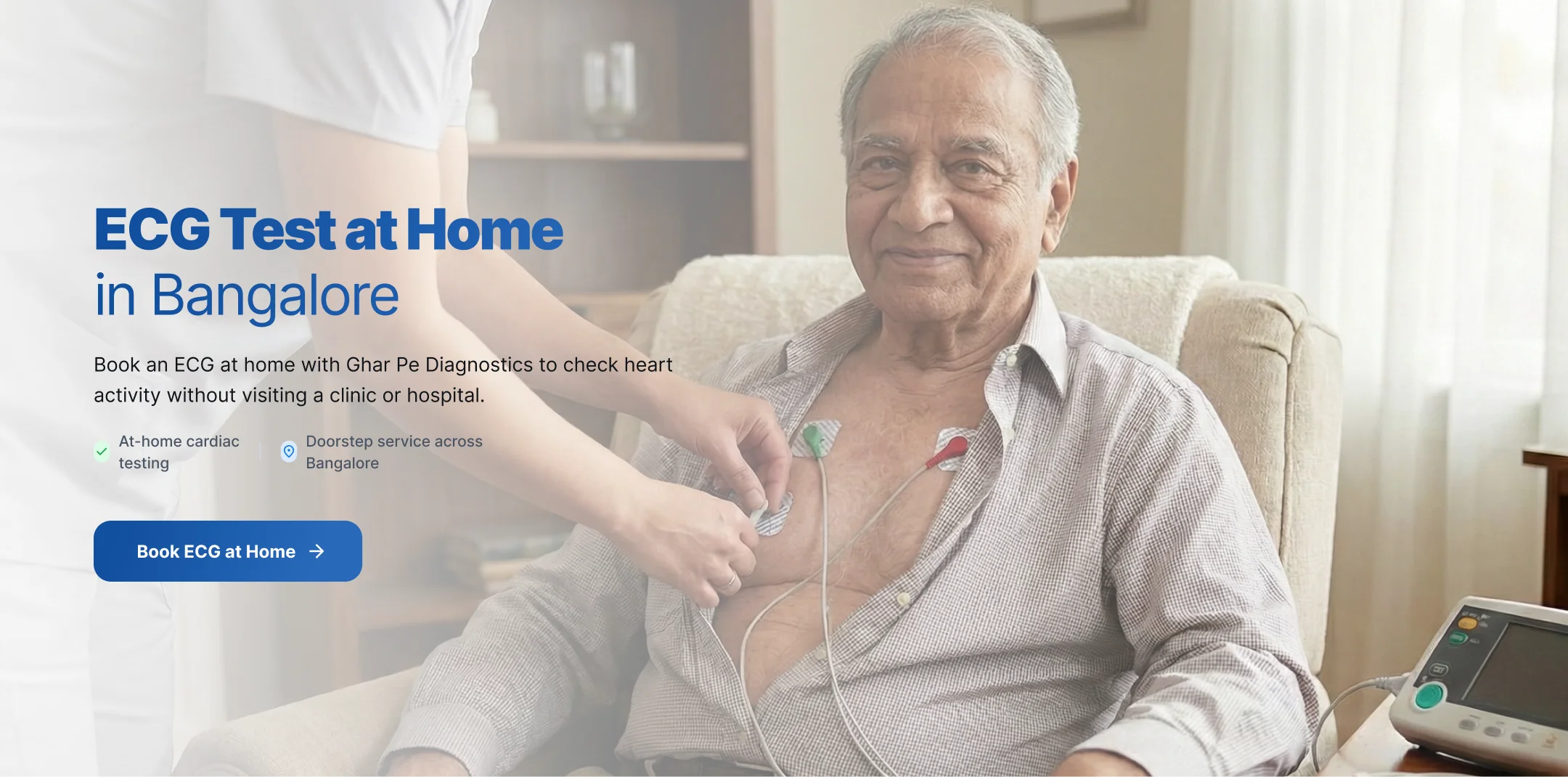
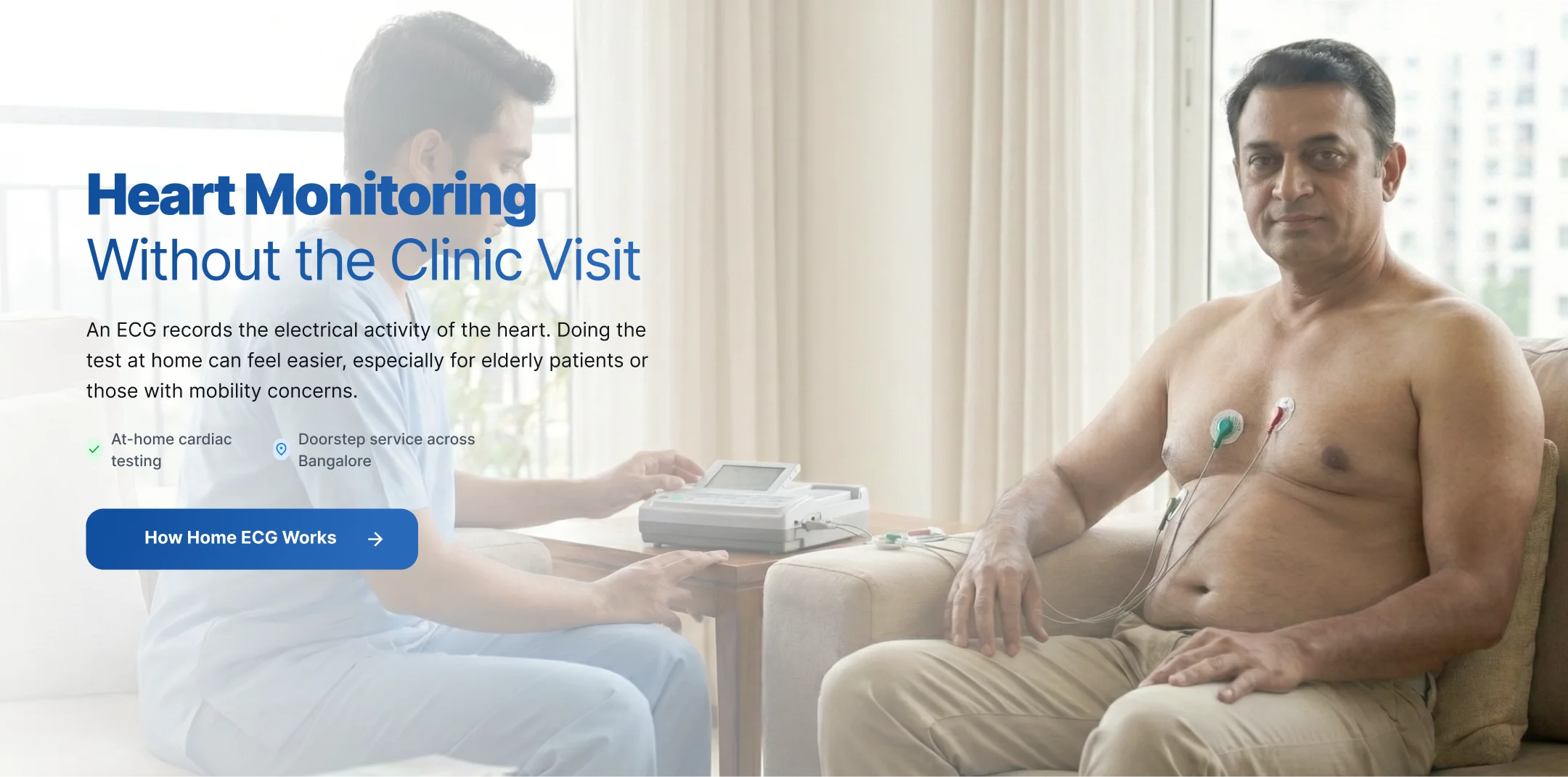
Ghar Pe Diagnostics (GPD) does 12-lead ECG at home across Bangalore. A trained technician records the ECG in about 15 to 20 minutes, a qualified doctor interprets it, and the report usually reaches you the same day.
Home ECG or Hospital? A Quick Guide
| Situation | Book ECG at home? | What to do |
|---|---|---|
| Palpitations that come and go, no other symptoms | Yes | Book, ideally with a doctor's advice |
| Pre-surgery ECG requested by your surgeon | Yes | Confirm the hospital accepts outside reports |
| Follow-up after discharge or heart treatment | Yes | Keep the discharge summary handy |
| High BP or diabetes, doctor wants a heart check | Yes | Book at a time that suits you |
| Doctor changed heart medicines and wants a repeat ECG | Yes | Book on the date your doctor gave |
| Mild chest discomfort already checked by a doctor | Yes, if the doctor asked for it | Share symptoms while booking |
| Sudden severe chest pain, sweating or fainting | No | Go to emergency now |
| Palpitations with chest pain or breathlessness | No | Go to emergency now |
Common Reasons to Book an ECG at Home
Palpitations
Racing, pounding or skipped beats are one of the most common reasons people get an ECG. A home ECG records your rhythm at that moment. If the palpitations happen only now and then, your doctor may follow up with a Holter monitor.
Before surgery or a procedure
Surgeons and anaesthetists often ask for an ECG before an operation, especially for older patients or people with heart risk factors. Doing it at home saves a separate trip, but check with the hospital first because some prefer their own ECG.
After hospital discharge
After a heart problem, a major surgery or a serious illness, doctors often want an ECG before the next follow-up visit. A home ECG avoids an extra trip while the patient is still weak.
High blood pressure, diabetes or high cholesterol
These conditions raise heart risk over time, so doctors often ask for periodic ECGs. Your doctor decides how often.
Medicine review
Some heart and blood pressure medicines can change heart rhythm. Doctors use repeat ECGs to see how the heart is responding.
Hard to travel
For elderly patients, people with limited mobility or anyone who finds OPD queues exhausting, a planned ECG at home is simply easier.
When Not to Book: Go to Hospital Instead
- Sudden, severe or crushing chest pain
- Chest pain spreading to the arm, jaw, back or shoulder
- Chest pain with sweating, nausea or breathlessness
- Fainting or collapse
- Sudden confusion or weakness on one side of the body
- A very fast or very slow heartbeat with dizziness or discomfort
In these cases, go to the nearest emergency department or call emergency services. Home ECG is for planned checks, not emergencies.
ECG, Troponin, Echo, Holter or TMT: Which Test Answers What?
An ECG is often the first heart test, but it answers one specific question. Your doctor may add others.
| Test | What it checks | When doctors use it |
|---|---|---|
| ECG | Heart rhythm and electrical activity at rest | Palpitations, chest discomfort, pre-surgery, follow-up |
| Troponin (blood test) | Damage to the heart muscle | Suspected heart attack |
| Echocardiogram | Heart structure, valves and pumping | Breathlessness, heart failure, valve problems |
| Holter monitor | Rhythm over 24 hours or longer | Palpitations that come and go |
| TMT (stress test) | How the heart copes with exercise | Chest discomfort during exertion |
GPD offers ECG at home. If your doctor also advises blood tests such as lipid profile or sugar, you can book lab tests at home in Bangalore separately.
How Booking Works
- Book on the ECG booking page or call or WhatsApp +91 9611508886.
- Share the patient's age, symptoms, address and prescription if you have one.
- The technician visits, places 10 electrodes and records the ECG while you lie still.
- A qualified doctor interprets the tracing, and the report reaches you on WhatsApp or email, usually the same day.
The ECG is currently listed at ₹750, and the home visit is free within 5 km of our branch. For preparation tips and the full service overview, read ECG at home in Bangalore. GPD covers areas such as Jayanagar, JP Nagar, Banashankari, BTM Layout, HSR Layout and Whitefield.
Book an ECG at Home
If your situation fits, book an ECG at home in Bangalore with Ghar Pe Diagnostics. We are available 8 AM to 8 PM, all 7 days.